If I had to choose between a massage gun and a foam roller, I’d pick the foam roller for most people.
It’s cheaper, works extremely well on larger muscle groups, lets you apply plenty of pressure using your bodyweight, and never needs charging.
A massage gun has one major advantage, though: convenience. It makes it much easier to target specific muscles without having to get on the floor and position your body over a roller.
Both can be useful for soreness, tightness, and short-term mobility, but they have different strengths. Here’s how they compare.
| Feature | Foam Roller | Massage Gun |
|---|---|---|
| Best for | Larger muscle groups | Targeted muscles |
| Pressure | High using bodyweight | Easily adjustable |
| Convenience | Good | Excellent |
| Price | Usually cheaper | Usually more expensive |
| Battery | None needed | Requires charging |
| Legs/glutes | Excellent | Good |
| Smaller muscles | Can be awkward | Excellent |
| Mobility exercises | More versatile | More limited |
| Portability | Good | Good |
Quick verdict: Go with a foam roller if you want the best value and mainly work on your legs, glutes, calves, and back. Choose a massage gun if you care more about convenience and targeting individual muscles.
What’s the Main Difference?
The biggest difference is how you apply pressure.
With a foam roller, you use your own bodyweight. This means you can create quite a lot of pressure, especially on areas such as your quads, hamstrings, glutes, calves, and upper back.
It’s simple as well. There’s no battery, no charger, and almost nothing that can really go wrong with it.
The downside is that some muscles are awkward to reach.
Take the biceps as an example. To foam roll them, you normally have to get onto the floor, position your arm over the roller, and use your other arm to support and move your body.
With a massage gun, you can simply sit down and work directly on the muscle.
That’s where massage guns shine. They make it easy to target areas such as the biceps, forearms, shoulders, and other smaller muscles without having to turn yourself into a yoga position on the floor.
One thing worth mentioning, though, is that a massage gun is not automatically better for the back. Unless someone else is using it on you, some parts of your back can actually be difficult to reach. For the upper back, a foam roller can be much easier.
Which Is Better for Muscle Soreness and Recovery?
Both can make sore muscles feel better, but I wouldn’t treat either one as something that dramatically speeds up recovery.
Sleep, nutrition, sensible training volume, and enough time between hard sessions still matter far more.
For general soreness across large areas, I prefer the foam roller.
After a hard leg workout, for example, you can quickly work across your quads, hamstrings, glutes, and calves without having to target every small area individually.
A massage gun makes more sense when you have one particular muscle you want to focus on.
If your forearms feel tight after training or you want to work on one small part of your shoulder, taking out a massage gun is much more convenient than trying to find a way to foam roll it.
You also don’t need to destroy yourself with either tool.
More pressure is not always better. A moderate amount that feels uncomfortable but manageable is usually enough.
Spending roughly 30 to 60 seconds on an area can be plenty, especially if you’re using the tool before training.
Which Is Better Before a Workout?
Both can work well as part of a warm-up.
A quick foam roll can make a stiff muscle feel looser before you start moving, while a massage gun can be useful when you want to target one area quickly.
But I wouldn’t spend 15 or 20 minutes smashing your muscles before training.
Keep it brief and then move into movements that actually prepare you for the workout.
For example, if your upper back feels stiff, you could spend a short amount of time using a foam roller and then follow it with your normal mobility work.
A foam roller also has an advantage here because you can use it for certain mobility exercises rather than only massage.
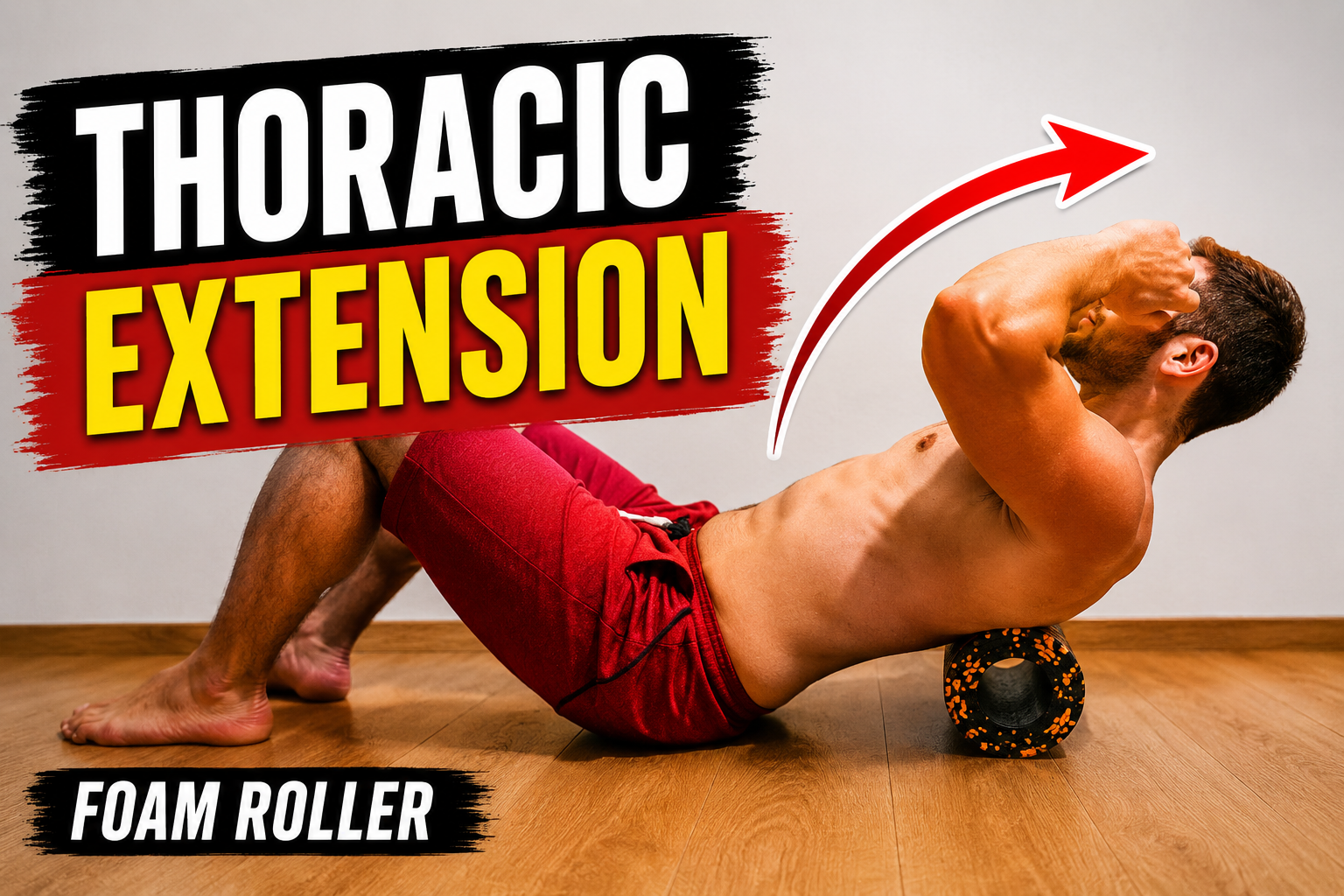
One example is the thoracic extension, where the roller acts as a support underneath the upper back.
How to Do a Foam Roller Thoracic Extension
Practical Tips for Using Either Tool
Whichever option you choose, there are a few things I’d keep in mind.
Start with moderate pressure rather than immediately trying to make it as painful as possible. You should feel the muscle being worked, but extreme pain isn’t the goal.
With a massage gun, start on a lower setting and increase it if needed.
Avoid hammering directly over bones, joints, the spine, or the front and sides of the neck. And if you have a fresh injury, significant swelling, unexplained pain, numbness, or something you suspect may actually be injured rather than simply sore, don’t just attack it with a massage gun or roller.
Recovery tools are useful for normal training soreness and tightness. They’re not a substitute for figuring out what’s wrong when something is genuinely injured.
Price and Value
This is where the foam roller has a huge advantage.
A basic foam roller is inexpensive and can last for years. There are no electronics, batteries, chargers, motors, or replacement parts.
Massage guns vary massively in price.
You can find relatively cheap models, while premium options can cost many times more than a foam roller.
That doesn’t mean they’re a waste of money.
If you use a massage gun regularly and love the convenience, it can absolutely be worth paying more.
But if you’re buying your first recovery tool, I think the foam roller gives you more value for your money.
My Foam Roller Pick
If you want something simple for your legs, glutes, calves, and upper back:
[Check My Recommended Foam Roller on Amazon →]
My Massage Gun Pick
If you care more about convenience and being able to target individual muscles:
[Check My Recommended Massage Gun on Amazon →]
Can You Use Both?
You don’t have to treat this as an either/or decision.
They actually complement each other very well.
You could use the foam roller for your larger muscle groups and then use the massage gun for areas that are harder to reach with the roller.
If you already own both, just use whichever one makes the most sense for the area you’re working on.
But I wouldn’t feel like you need to buy both.
Which One Should You Buy?
If I could only keep one, I’d keep the foam roller.
Most of the areas I personally want to work on are large muscle groups like the quads, hamstrings, glutes, calves, and upper back and a foam roller handles all of those very well.
It’s also cheaper, always ready to use, and versatile enough to use for some mobility exercises too.
Go with the foam roller if you mainly want something simple, inexpensive, and effective for larger muscle groups.
Go with the massage gun if you hate rolling around on the floor, frequently want to target smaller muscles, and are happy to pay more for convenience.
[Check My Recommended Foam Roller on Amazon →]
[Check My Recommended Massage Gun on Amazon →]
Final Verdict
Both massage guns and foam rollers can be useful recovery tools.
The foam roller wins for price, simplicity, larger muscle groups, and overall value.
The massage gun wins for convenience and targeting specific muscles.
If you’re completely undecided and this is your first recovery tool, I’d start with the foam roller.
You can always add a massage gun later if you find yourself wanting something more targeted.
Just remember that neither tool is going to compensate for poor sleep, bad nutrition, excessive training volume, or not giving your body enough time to recover.
They’re useful tools but not magic recovery machines.