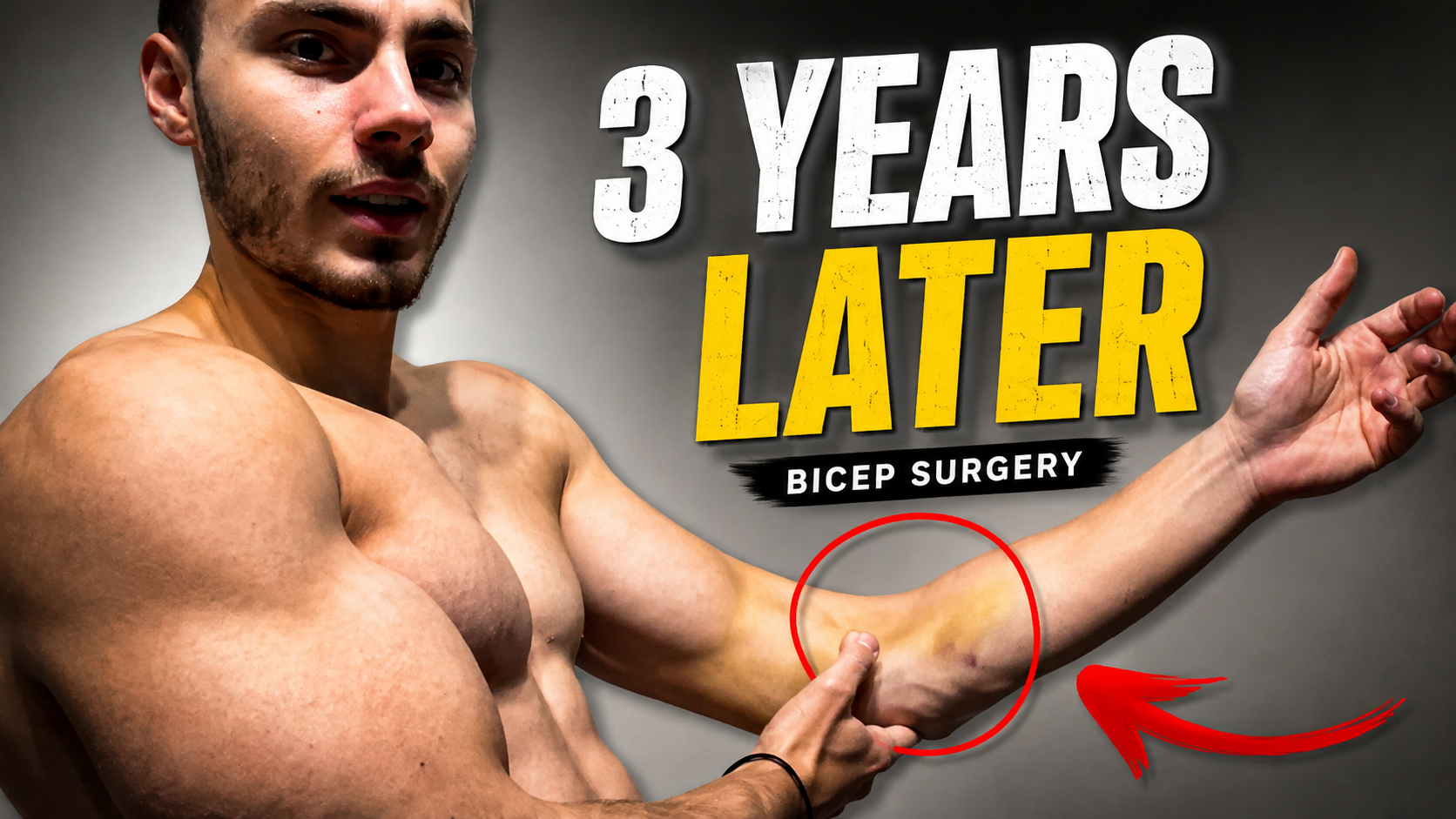
Around three years ago, I completely tore my left distal biceps tendon.
I made a few videos about the injury and surgery at the time, but those were recorded during the early stages of recovery. Back then, I originally planned to document the healing process every week.
The problem was that there really wasn’t much to show.
For a while, my arm was basically stuck in one position. Week by week, I was gradually allowed to straighten it a little further until I eventually regained full extension.
Because of that, I never continued with the weekly updates.
Over the last few years, however, I’ve continued receiving comments, YouTube messages and even emails from people asking how my biceps eventually healed.
Do I still have pain?
Did I get my strength back?
Can I train normally?
Are there exercises I still avoid?
So now that it’s been almost three years since the surgery, I thought it was finally time to give a proper long-term update.
Wanna Watch The Video Instead? Click Here
How I Tore My Distal Biceps Tendon
The injury happened around three weeks before I was supposed to compete in a Men’s Physique competition.
At the time, I was dieting very aggressively.
I was eating around 1500 calories per day, training hard in the gym, doing cardio and generally pushing my body pretty far.
Looking back, I was probably not in the best condition to start experimenting with difficult calisthenics skills.
But that’s exactly what I did.
I had trained planche for years, usually on the floor or on parallettes.
What I hadn’t really done was planche training on gymnastic rings.
If you’ve trained on rings before, you know how much instability they add.
Even something relatively basic like dips can feel dramatically harder on rings because you suddenly have to stabilize the rings while performing the movement.
For some reason, that day I decided to try the planche on rings.
I managed to hold the position briefly.
Then my biceps tendon tore.
I still have footage from around the injury, and you can clearly see that the shape of the biceps changed afterward.
Going to the Hospital
I remember going to the hospital and explaining what had happened.
One of the first people who looked at the arm suggested that it could potentially be a partial tear.
But I was almost certain something more serious had happened.
I had felt the injury, and visually the biceps looked very different.
The muscle had noticeably moved upward compared with the other arm.
After further assessment, it became clear that I had suffered a distal biceps tendon rupture.
Surgery or No Surgery?
When you rupture a distal biceps tendon, treatment isn’t necessarily identical for every person.
Non-surgical treatment can sometimes be considered, particularly depending on age, activity level, health and the person’s individual goals.
For someone young and very active like me, however, regaining as much strength and function as possible was extremely important.
One of the major concerns with leaving a complete distal biceps rupture untreated is losing some strength, particularly with forearm supination — the movement you use when turning your palm upward.
After discussing the injury and my options, I decided to have surgery.
Timing was another factor.
With distal biceps repair, surgeons often prefer to perform the operation relatively soon after the injury because the tendon can retract and scar over time, potentially making a later repair more complicated.
In my case, that meant getting imaging, appointments and surgery organized fairly quickly.
I Still Competed After Surgery
One of the stranger parts of this whole story is that I still decided to enter the physique competition afterward.
Unsurprisingly, it didn’t go particularly well.
I basically came last.
I was extremely cautious with the repaired arm and was scared to properly tense and pose.
During the early phase after surgery, you’re constantly aware that the tendon has just been repaired.
Even basic movements feel like something you have to think about.
My doctors were very conservative about how much load I should place through the arm early on, so standing on stage and trying to flex confidently wasn’t exactly easy.
But I still went through with the competition.
Looking back, it’s a pretty strange memory.
How Does My Biceps Feel 3 Years Later?
This is probably the main reason you’re reading this article.
Physically, the recovery has gone very well.
I regained full elbow extension.
I can rotate my forearm normally.
My strength also returned to a level where I can perform most of the exercises I did before the injury.
I can do weighted pull-ups.
I can bench press.
I can train my back, chest and arms normally.
During everyday life, I generally don’t think about the fact that my biceps tendon was surgically repaired.
That is probably the biggest difference between the early recovery phase and where I am today.
At first, the injury dominates everything you do.
Years later, it can become something you barely think about.
The Biggest Remaining Problem Is Psychological
Interestingly, the biggest limitation I experienced wasn’t physical.
It was psychological.
For a while, I didn’t even like watching people perform planche or other high-risk calisthenics movements.
I’d see somebody doing a planche on Instagram and immediately want to scroll past it.
Watching people do reckless or high-risk strength movements in person made me uncomfortable too.
I think the injury created a very strong association between certain movements and the possibility of another tendon rupture.
It’s similar to someone who experiences a serious accident and becomes much more cautious afterward.
Even once you’re physically capable of doing something again, your brain doesn’t necessarily forget what happened.
That’s still something I notice to some extent today.
There are exercises I’m physically capable of doing that I simply don’t feel the same confidence performing anymore.
Planche is a good example.
Could I progressively train toward it again?
Probably.
Do I particularly want to put myself through another tendon injury and surgery just to prove I can?
Not really.
My risk tolerance has changed.
Numbness After My Biceps Surgery
One thing I experienced during the early stages of recovery was numbness in part of my forearm.
For example, when hot water touched that part of the arm, the sensation felt noticeably reduced.
Fortunately, that gradually improved over the following months.
Temporary sensory changes can occur after surgery because nerves around the surgical area can become irritated.
My sensation eventually returned, but anyone experiencing persistent numbness, weakness or worsening neurological symptoms after surgery should discuss it with their medical team rather than assuming it will automatically resolve.
Do I Still Have Pain?
Most of the time, no.
I can perform the overwhelming majority of my normal exercises without pain.
There is, however, one movement that still bothers me:
diamond push-ups.
When I bring my hands together into the traditional diamond position and perform push-ups, I sometimes feel discomfort around the elbow area of the repaired arm.
Because of that, I simply don’t perform them.
Instead, I use close-grip push-ups while keeping my hands slightly farther apart.
I also like doing them using push-up handles or parallettes.
That lets me train my triceps with a similar movement while avoiding the exact hand and elbow position that bothers me.
For me, that’s an easy trade-off.
There is no reason to force one specific variation when several pain-free alternatives accomplish almost the same thing.
Can I Do Pull-Ups After Distal Biceps Surgery?
Yes.
In my case, I eventually returned to pull-ups successfully, including weighted pull-ups.
I can also hang from the repaired arm.
Interestingly, this is another place where the psychological side sometimes shows up.
I’ve physically demonstrated to myself that the arm can tolerate a lot of load.
But occasionally my brain still hesitates when all of my bodyweight is being supported by that repaired side.
That doesn’t necessarily mean the tendon is incapable of handling the movement.
It simply shows how long confidence can take to catch up after a major injury.
Does My Repaired Biceps Look Normal?
Overall, I’m very happy with how the arm looks now.
If you weren’t specifically comparing both arms and looking for differences, I don’t think most people would know that one of my distal biceps tendons had completely ruptured and been surgically repaired.
There may be subtle differences between the two sides, but cosmetically the result ended up being far better than I feared when the injury first happened.
Was Distal Biceps Surgery Worth It for Me?
For me personally, yes.
I’m young, active and training has been a major part of my life for years.
My priority was regaining as much strength and function as possible.
Almost three years later, I can train normally, perform weighted pull-ups and use the arm without thinking about it during most of my day.
That doesn’t mean surgery is automatically the right choice for everyone with a distal biceps rupture.
Age, activity level, medical history, the type of tear and individual goals all matter.
This article is simply my experience.
If you’re dealing with a suspected or confirmed distal biceps rupture, your treatment decision is something to discuss with an orthopedic surgeon who can assess your specific situation.
Final Thoughts
Three years after tearing my distal biceps tendon, the outcome is much better than I imagined when the injury first happened.
Physically, I would consider the arm largely recovered.
My mobility is back.
My strength is back.
I can perform almost all of my normal training.
The one exercise that consistently bothers me is the traditional diamond push-up, so I simply use a different close-grip variation.
The bigger lasting effect has been psychological.
I’m still more cautious with exercises like planche and other movements that place large amounts of stress through the arms.
But during normal life and most of my training, the injury is no longer something I think about.
And after going through a complete tendon rupture, surgery and rehabilitation, that’s probably the best outcome I could have hoped for.