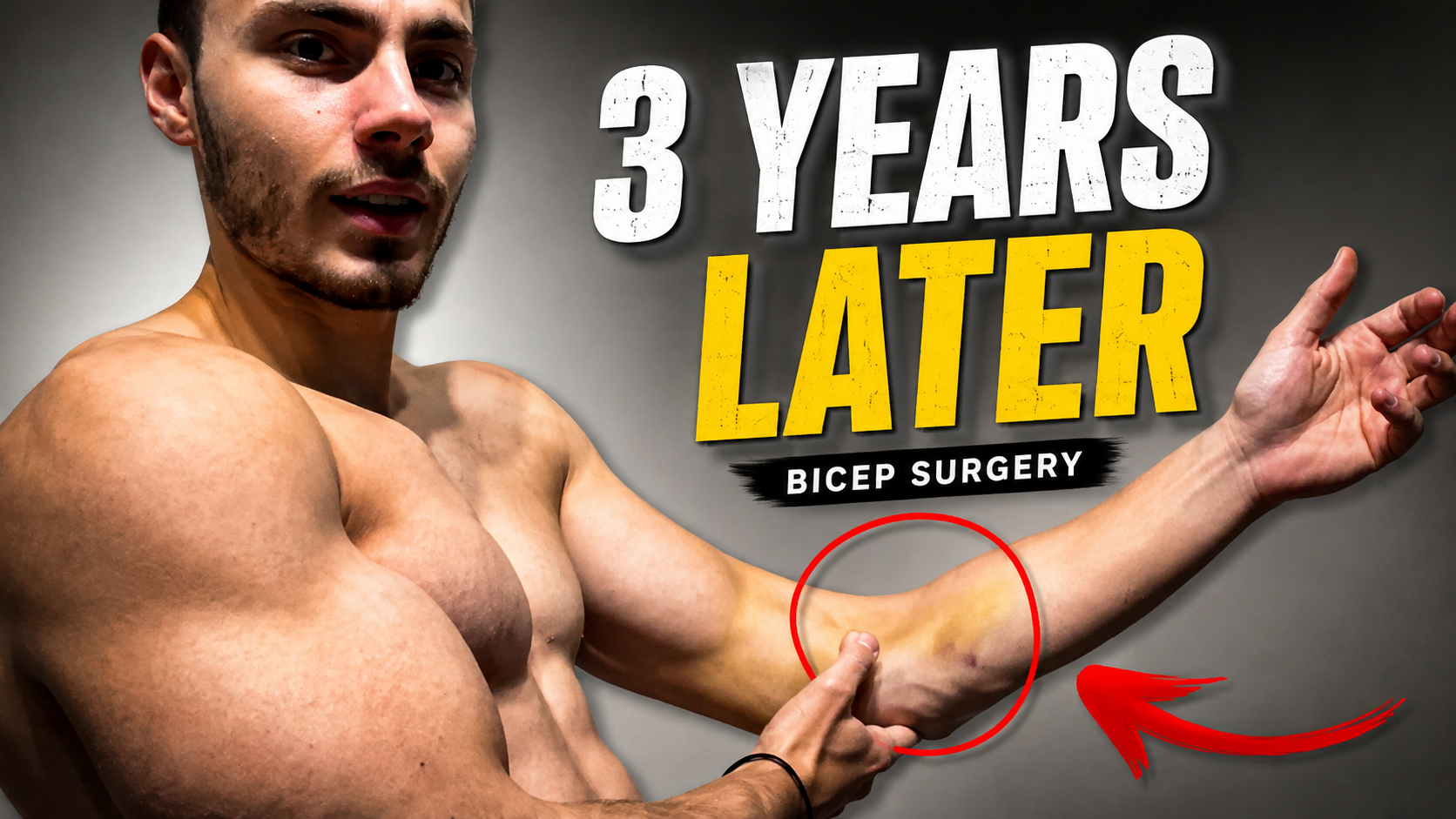
If you’re someone who goes to the gym every day, there’s a pretty good chance you’ve seen those crazy videos on social media where someone suddenly tears their bicep tendon. I always thought they looked painful and kind of strange, but I also told myself: “That’s never going to be me.”
Fast forward a few months, and I was the one on the floor, staring at my arm in shock, realizing I had just joined that club. What followed was bicep tendon tear surgery and one of the hardest recoveries I have ever gone through.
I was preparing for a men’s physique competition at the time. I was on an extreme caloric deficit, training almost every single day, and my body was clearly under a lot of stress. One day, I decided it would be a good idea to test some calisthenics moves on gymnastics rings. I went for a planche, tried holding it longer than my body could handle, and suddenly I heard a tearing sound. A second later, I was on the ground in disbelief at what had just happened.
That’s how quick an injury like this can happen. Before I explain the surgery and recovery, let me quickly break down what a bicep tendon tear actually is.
What a Bicep Tendon Tear Actually Is
There are two main places the bicep tendon can tear:
- Proximal tear (shoulder) – more common, usually less serious, sometimes people don’t even get surgery.
- Distal tear (elbow) – less common, but more serious because you can lose 30–40% of your pulling strength if it’s not repaired.
Mine was a distal bicep tendon tear. Typical signs are a “pop” sound, bruising, weakness when bending or rotating the arm, and sometimes that “Popeye” bulge in the muscle.
Deciding on Surgery
I was already 100% sure of what I had torn, I could feel it immediately and knew it wasn’t just a strain. I even told the doctors what it was, but of course they wanted to confirm it with an MRI, so that’s what we did. The scan showed exactly what I expected: a distal bicep tendon tear.
Technically, distal tears don’t always need surgery, but most research shows that without repair you risk losing strength and mobility long term.
Since I’m young and fitness is a huge part of my life, I decided bicep tendon tear surgery was the best choice for me. It’s usually a 1–2 hour procedure where the tendon is reattached to the bone with anchors. The risks are low, but the recovery is long and honestly, that’s the hardest part.
The First Phases
The first few weeks were brutal. I couldn’t lift anything with that arm. Even accidentally flexing my bicep for a second sent pain shooting through me.
Then came the challenge of getting my arm to straighten again. It had been stuck in a shortened position, and fully extending it was so uncomfortable. After about 3–4 months of consistent rehab, I was finally able to extend and rotate it normally again.
Even 6–7 months later, a part of my forearm was still numb. Apparently that’s common because nerves sometimes get irritated during surgery, and they take longer to heal (anywhere from 6–12 months or more). Strength also took a while to come back. I think a lot of that wasn’t just the tendon, it was my brain holding me back. The body has a way of protecting itself after trauma, and I felt a mental block whenever I tried to push too hard.
One Full Year Later..
It’s now been over a year since the injury, and I’d say I’ve regained about 98% of my strength. I can do weighted pull-ups, lift heavy, and train hard again without pain.
The only exercises that still feel awkward are close-grip bench press and diamond push-ups. My guess is the angle stresses the joint differently, and maybe the surgery slightly changed how the tendon reacts in that position. Still, compared to where I was a year ago, that’s a small issue.
What surprised me was how much of this recovery was mental. I still haven’t gone back to attempting skills like the planche. There’s a block in my head, and honestly, I’m fine with that. It’s my brain’s way of keeping me safe, and I’d rather train smart than end up back on the surgery table.
If you’ve been through something similar, don’t underestimate this part. Fear of reinjury is real, and it takes time to rebuild confidence.
What Actually Helped Me in Recovery
Looking back, the biggest thing that helped me was just keeping my arm active. I do not mean lifting weights, obviously that was not possible, but doing small mobility exercises and keeping the joint moving as much as I safely could. At first it was frustrating because it felt like nothing was happening, but over time those little movements really added up.
I also started with the lightest resistance bands just to get the muscle firing again. In the beginning it honestly felt pointless, but it gave me something to work on and slowly built confidence back in my arm.
Food was another part of the process. I made sure I was eating enough protein and I added collagen with vitamin C after reading it helps tendons. It was not a miracle, but it felt like I was supporting the recovery in every way I could. The hardest part of recovery was patience. Progress was so slow that some weeks it felt like nothing was improving, but in reality all those small steps kept stacking up.
I also wrote more about fitness, recovery, and nutrition tips on my blog here